- Turnaround
- Three weeks, fixed
- Price
- Fixed per build, quoted first
- Stack
- Yours or mine
- Delivery
- Unbranded. I never appear
Take law firm work without hiring for it. Say yes to the brief. Three weeks later your client has a site with your name on it — and nobody emails you about it again.
Five ways to answer a law firm brief.
Four of them cost you something you do not get back. One does not.
| The answer | Quoted same day |
Fixed cost |
Legal- specific |
Your name on it |
Nobody emails you |
Margin known upfront |
|---|---|---|---|---|---|---|
|
Send it to me Unbranded, three weeks, fixed cost quoted from your brief. You stay the only contact your client has. |
✓ | ✓ | ✓ | ✓ | ✓ | ✓ |
|
Say no The firm asks who has done this before. Somebody has, and they take the retainer and the rest of the client's work with it. |
✕ | ✕ | ✕ | ✕ | ✕ | ✕ |
|
Build it in-house Three weeks of your team on a practice-area tree and bar disclaimers nobody there has built before. |
✕ | ✕ | ✕ | ✓ | ✕ | ✕ |
|
Hire for it Someone who knows the sector, on your payroll, for a pipeline that is one brief deep. |
✕ | ✕ | ✓ | ✓ | ✕ | ✕ |
|
Pass it to a freelancer Cheap until the third revision round, and every email about it still comes to you. |
✕ | ✕ | ✕ | ✓ | ✕ | ✕ |
The rate sheet is not on this page — this site sells to firms directly too, and a wholesale number next to a retail one helps neither of us. Ask, and you have it the same day.
Your margin
2–3×What agencies typically bill their own client against one fixed cost per build. The margin is yours, and it is predictable because the cost is quoted before anything starts.
Monthly care is on the same sheet, at a wholesale rate you mark up like anything else.
Say yes on the day the brief lands.
Five things change, and none of them is taste. Each one is below as the thing itself, not a description of it.
It is fast on a phone, and you never had to ask.
Cold cache, throttled to 4G, on a 390-wide screen — which is how your client's client actually arrives. The speed number is in the agreement, not the brochure.
Your client adds the new associate without you.
Name, role, bar admissions, a paragraph, save. Eight labelled boxes, no layout to break, nothing to drag. This is the screen that decides most of these deals, so here it is from the theme that ships.
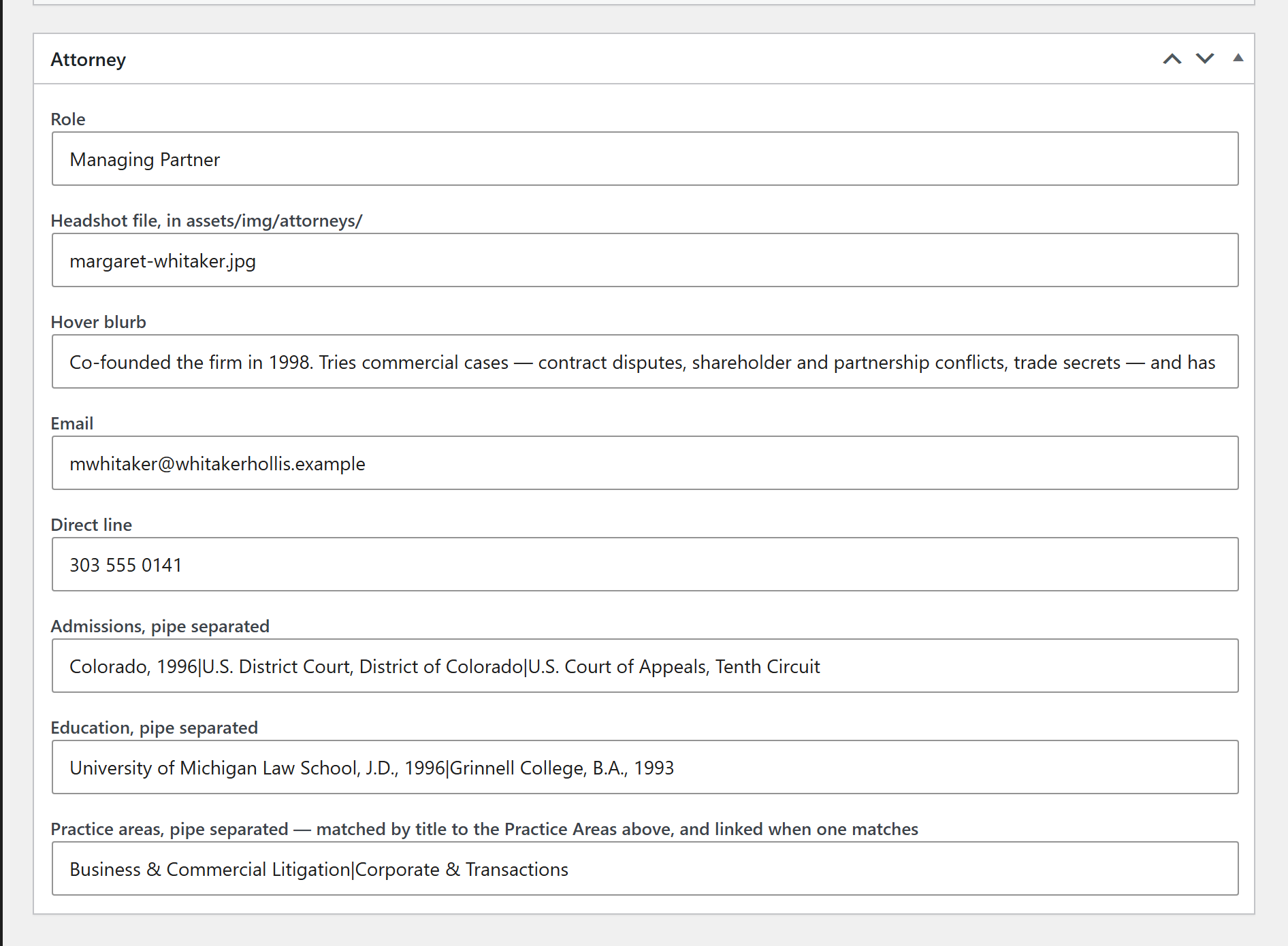
…and it appears everywhere it should.
The roster, the bio page at its own URL, the practice-area cross-links and the intake form's matter list all update from that one screen. Nobody emails you to change a phone number.
You put your name on the code without reading it first.
Chrome's own view-source on an attorney page. Nothing highlighted, nothing injected — the gutter and the wrap checkbox are the browser's. You are not waiting to find out what your client's competitor got.
The pages nobody briefed are finished too.
The insights index, an article, and a 404 that lists every route rather than apologising. This is where a build usually shows you it was a template, and it is where your client's partner will click.
Your house stack
- Elementor
- Divi
- Bricks
- Beaver Builder
- WPBakery
- Oxygen
- Gutenberg
- Astra / Kadence / GeneratePress / Genesis child
- Webflow
A hand-written theme is the default and it is what the fixed cost buys. If your shop standardises on something, I build in that instead. One thing genuinely changes: the under-2.0-second clause is written against the hand-written theme — on a builder it is measured and agreed per build. The three weeks, the unbranded delivery and your client never hearing from me do not change at all.
The last one I built, scored in public.
Whitaker & Hollis is a fictional firm, built so there would be one law firm site I could publish every number on. Everything else about it is real — including the page that misses.
The failing page is published because the easiest thing you can do with a supplier's demo is run Lighthouse at it, and finding a miss I had not mentioned would be worth more to you than the passes. Underneath: a hand-written theme, no page builder, and zero plugins behind the content types — not even a field builder, which is the usual answer and is one more thing to be missing on a fresh install.
The whole thing, top to bottom.
The homepage at desktop width, scrolled at reading speed. Every page it links to is in the live demo, and the case study publishes the number for each one.
One person, and here is what that means for you.

- Capacity
- Two builds at a time
- A supplier running six is handing you the leftovers of the other five.
- Availability
- Next slot: available now
- Not a queue. Brief me this week and the three weeks start when the content lands.
- Ownership
- Your code, from week one
- In a repository you control from the first commit. If I disappear, any WordPress developer picks it up.
- The date
- Deposit back if I miss it
- A term, not a reassurance. It answers the real risk of hiring one person.
- Hours
- 9am–1pm Eastern, daily
- India. Your morning, my evening. Anything sent outside it has an answer waiting.
- Paperwork
- Yours, signed
- Your contract and your NDA. A clause naming your clients off limits, if you want one.
Everything else, in writing.
In the agreement rather than in an understanding — including the two answers that cost me the work.
| You supply | You get back | |
|---|---|---|
| Content | Practice areas, attorneys, existing copy — in whatever state it is in | All of it placed, typed and cross-linked |
| Imagery | Photographs, or a note to source stock | Encoded at the two sizes the page serves |
| Brand | Logo, colours, type if you hold the licences | Applied throughout, unbranded by me |
| Stack | Your house builder, if you have one | Built in it, or on a hand-written theme |
| Feedback | One person who consolidates it into the rounds | Two revision rounds inside the three weeks |
| Hosting | Yours, or leave it on mine until you move it | The repository, from the first commit |
| Not in scope | Case management, a blog system, ongoing SEO retainers | Named in the agreement, not discovered later |
I also sell direct to firms at retail — that is what the rest of this site is. Your clients are not a market I approach. If you would rather that were in writing, it goes in the agreement.
The nine answers — unchanged, and still closed by default
What is in the build, and what is not
Anything in the right-hand list can be added and quoted. It is here because unsaid scope is what turns a three-week project into a four-month one — and on white-label work it is worse, because you will already have quoted your client.
Included
- A custom WordPress theme — hand-written by default, or built in your house stack if you have one
- Native content types for attorneys and practice areas, editable by a non-technical person. On the default build there is no plugin to install and none to keep licensed. New photographs are the one exception and come through me, encoded
- Mobile-first design across phone, tablet and desktop
- A working intake form — notification, spam protection, confirmation, and I test it on real devices
- On-page SEO — titles, meta, headings, alt text, sitemap, robots.txt, structured data that validates
- A performance number in the agreement — Lighthouse mobile 90+ and largest content painted under 2.0s on 4G on the default build, measured on the delivered site at handover on the hosting named in the agreement. On a builder stack the number is agreed per build
- Bar advertising disclaimer placements — footer, testimonials, intake consent
- Handover — a walkthrough plus a short written guide you can rebrand
- 30 days of bug fixes after handover at no charge
Not included unless quoted
- Copywriting — you supply text, I edit for length and flow
- Photography, shoots, and stock licensing
- Logo and brand identity design
- Ongoing SEO, link building, or paid ads
- Case management systems, client portals, e-signature, payment processing, live chat
- Blog migration over 20 posts
- Multi-language versions
- Legal and bar compliance review — I build in the standard placements; your client's counsel checks the final copy against their jurisdiction
How paying works
- Half to book the slot, half before it goes live
- The balance lands on approval, before the site is public. Once we have done a build together, net 15 from delivery instead.
- Miss the design date and the deposit comes back
- If the mockups are not with you on the day I said, you get the deposit back and walk. It is the stage where your money is exposed and my promise is not yet proven.
- Content within 30 days, or the slot re-queues
- If your client's material has not arrived a month after the deposit, the project pauses and takes the next free slot rather than holding one empty. The deposit stays good for six months.
- Rush is priced, not refused
- Compressing three weeks is possible and it carries a surcharge, because the alternative is agreeing to it and then missing it — which costs you more than the surcharge does.
- After the first 30 days, fixes are hourly when you ask
- No monthly fee, no minimum, no contract, and the rate is on the sheet. Most builds never come back.
How the work runs, and who owns it at the end
- You are the only point of contact
- I do not speak to your client unless you ask me to and sit in on it. If they need to be on a call for a technical answer, you invite me.
- You supply content and consolidate feedback
- All of it, in one voice. Feedback arriving from three people at your client is the single most reliable way to lose a fixed timeline, so it comes through you. If a round arrives contradicting the last one, I will say so before building it rather than after.
- Unbranded delivery
- No credit line, no backlink, no comment in the source, nothing in the theme name. It is your build.
- Portfolio rights are yours until you grant them
- I do not show the work anywhere without your written agreement. If you are happy for me to, say so in the agreement rather than afterwards.
- Revisions: two at design, one after build
- Same as retail. Design is approved before a page is built, because finding out the direction is wrong on a mockup in week one costs a fraction of finding out on a finished site in week three.
- Free fixes for 30 days, counted from handover to you
- Not from the day your client goes live, which may be a quarter later. It covers things that are broken, not changes: a form that stops sending, a layout that breaks on a phone, something an update knocked over. A new page or a new look is new work, and I will say so before doing it rather than after.
- You own it, on final payment
- Design, code, content — yours, or your client's, whichever your contract with them says. No lock-in, no licence to renew, nothing held back, and you do not need me in the loop to move it anywhere.
Will you go around us to our client?
No, and it is in the agreement rather than in my assurance. You are the only point of contact, I do not appear in the code, and I do not put the work in a portfolio without your written agreement. I sell direct to firms as well — that is what the rest of this site is — and your clients are not part of that. If you want a non-solicit clause naming them, I will sign it.
We standardise on Elementor. Can you work in it?
Yes — and the same goes for Divi, Bricks, Beaver Builder, WPBakery, Oxygen, native Gutenberg blocks, a child theme on Astra, Kadence, GeneratePress or Genesis, or Webflow outside WordPress. It is quoted from the brief, because it changes the work. The default, if you have no preference, is a hand-written theme with no builder and no plugin behind the content types: no licence for your client to keep renewing to stay able to edit their own pages, and no builder update that can break a site you handed over eight months ago. The one thing that moves with the stack is the speed clause — under 2.0s is written against the default build, and on a builder we agree the number per build instead.
Do you handle bar advertising compliance?
I build in the standard placements — a site-wide footer disclaimer, a prior-results notice on any testimonials or case results, and a no-attorney-client-relationship notice on intake forms. I am not qualified to certify a site against a state bar's advertising rules and you would not want me to be; your client's counsel signs off the final copy. Worth raising with them early, because most people pitching a small firm have never heard of it.
Why only law firms?
Because the second niche is where the answers stop being specific. Every hour I have spent on this went into one kind of site, which is why the brief can be short and the estimate can be fixed. If you need a restaurant built, I am the wrong supplier and I will say so.
How many of these have you shipped?
The reference build is on this site, scored against a published 24-check standard with its failures named. I am not going to inflate a number at you — you can open the demo, run Lighthouse at it and read its source, which tells you more about what you would receive than a count would. If a case count is a hard requirement for your procurement, I am probably early for you.
Send me one brief.
Tell me about a law firm client in your pipeline and I will tell you what it would take, what it would cost you, and whether I am the wrong person for it.
On the form, pick “I’m an agency looking for a white-label builder” — it routes to me directly rather than into the firm enquiries.